The technology, at least software-wise (at either company, frankly) was not bad, even by today's standards. It worked to specifications and with a bit of work could be customized, with a high degree of reliability to send me only information that was relevant. I left IBM in 1996 to pursue for a couple of years the fruits of being an early stage blogger (that is a tale for another day) and consider both companies products in the realm of "noble failure". I believe they failed primarily for two reasons : In 1995 (or maybe 1996) I got to join a group of IBMers on a tour of the MIT Media Lab which at the time was run by Nicholas Negroponte (though Walter Bender was already very influential). Negroponte is widely credited with the notion of "The Daily Me" and there was one project specifically working on this and several that were peripherally related. One of those projects was RINGO. RINGO was (or perhaps still is) a music recommendation engine. Though music and news aren't related the notion of recommendations as a solution for the serendipity problem and potentially for the actual profiling did cross my mind. For now, it still remains largely potential. FriendFeed does solve a lot of the serendipity issue. I wind up seeing a lot of stuff I never would have asked for that I truly enjoy seeing. Like this, this and this. There are plenty of challenges with the automation still. On one hand, if there is any kind of reward system that can be schemed (Digg, for example) it will be schemed and often produce less than desirable results. FriendFeed is by no means perfect for this yet, but it's getting pretty close for me. But getting pretty close for me is not good enough. Unlike Hutch Carpenter, I actually *am* a geek (so is Hutch, but if his denial makes him feel better, fine by me!). So for me, FriendFeed is becoming a prototype of "The Daily Me" and I'm quite pleased with the progress that has transpired since the mid 1990s. But most of the progress is still yet to come. My geekdom positions me for screwing around with things, figuring out how best to hide 50 versions of the same thing showing up in my feed. Geeky as I am, I have not completely mastered this yet. The percentage of the world's population that would screw around with the FriendFeed hide tools to the degree I have is negligible (I'd guess under 1% even in developed countries). 1% doesn't get you to anything that is the XYZ for the next generation. FriendFeed needs a whole lot of work if it's to fulfill the vision of "The Daily Me". I know some of you will say, "But FriendFeed isn't trying to do that, it's an aggregation system for sharing lifestreams." To you people I would say only this: I hope you will expand your thinking a little bit and consider the notion of it. While it's true that FriendFeed is an aggregation system for sharing lifestreams, that is a semantics game because OF COURSE "The Daily Me" would include pictures of what your friends did this weekend, what songs they're listening to and what movies they liked and what restuarants they ate at that they thought were great. Of course it would. Someday, I think it will. Back in 1993 when I was Louis Gray's age and he was going to the DMV for the first time to get his drivers' license I began a three year whirlwind of focusing on an online personalized news and information service. The Internet was not yet pervasive in 1993, but online connectivity via modems was becoming widely accessible. My whirlwind tour spanned two companies, initially a start-up joint venture between MCI and Equifax (FYI Online) and then IBM. Though I only was highly focused on personalized news and information for a few years, I have never stopped thinking about it.
Monday, July 7, 2008
Will FriendFeed Be "The Daily Me" Newspaper for the Next Gen?


Sunday, July 6, 2008
Twitter and FriendFeed: Both Will Thrive, Both Will Survive
Hey Jason,
it is good to see you on FriendFeed and I hope you find it a useful tool for your endeavors. I can’t help but think you will. I think for the first time during the 2000s I was in front of you on the curve with something (besides watching a boatload of video on my iPhone but I don’t really consider that an Internet thing).
A few things.
1. It’s not odd to me at all that you (or Loic, or Arrington or Scoble) would garner followers on FriendFeed more rapidly with FriendFeed than Twitter. You all had a group of built-in, click-happy, early-adopting followers already on Twitter. I’d guess the correlation between your followers on FriendFeed also following you on Twitter is nearly 100% (same for Loic, Scoble, etc). When Twitter was born there was no built-in group of click-happy, early-adopting subscribers to follow
2. Twitter and FriendFeed are NOT the same service. While you can do much of what you can on Twitter (promotionally) on FriendFeed they are not the same things. I view Twitter as primarily a communication service and information becomes a component as a result of the communication. FriendFeed is primarily an aggregation/information service where communication becomes a component around the information. It’s a very different model
3. Twitter still has huge opportunities (HUGE!). While I’m not a huge fan of Twitter and prefer FriendFeed this is based on a personal bias. Twitter is still better for simple broadcasting and simple direct messaging. I don’t believe FriendFeed has any objective to become primarily a communication service or offer direct messaging. In fact, I hope they do not get caught up in any of that.
4. SMS is huge. Twitter is perfect for SMS. Twitter hasn’t even remotely begun to capitalize on the opportunity it has as a communication service via SMS. I’m not sure it makes any sense whatsoever for FriendFeed to worry about SMS. At least for now, I really hope they are not thinking about it at all.
You, Scoble, Arrington etc quite are not the typical use cases for either Twitter or FriendFeed. You and Arrington primarily (seemingly, I could be wrong) see these tools as promotional for your products. While that *is* a use case for both services (and I have no qualms with that) I think promotion/broadcast are on a sliding scale.
I’m not sure what the continuum is – perhaps it’s from broadcast/promotion to information and communicating with people. While I think there is a promotion component for everyone (if you buy into “you are your brand” thinking) the weighted importance of broadcast/promotion will not likely be heavy for the mainstream user. Scoble may be in a league of his own at 100% on both ends of the spectrum! But on a sliding scale you and Arrington definitely are slid closer to broadcast/promotion than communicating with other people. Whatever the sliding scale is, there is a pretty wide range of use.
While I understand the Twitterati (I can’t believe by the way, that ‘Twitterati’ makes it through the MSFT spell check!) is very down on Twitter being down all the time, and I understand the reliance on FriendFeed during the downtime, it’s definitely not an either/or situation.
Will FriendFeed kill Twitter?
Did the web kill e-mail?
Rhetorical question. :-) While it’s certainly in the realm of possibility that Twitter will kill itself, at this juncture, reading the tea leaves that seems highly unlikely as the reason that people are bitching so passionately at times is because they love them some Twitter.
Jason Calacanis is to Michael Arrington as Ginger Makela is to...?
Finally, I hear a lot of ranting about FriendFeed just winding up being an echo chamber. There is more than a little truth to this because of the nature of things. There are a lot of early adopters and bloggers on FriendFeed right now who want to promote their stuff. Then this fact of life comes into play: if you digg, delicious, stumble or in some other way share MY stuff, I will be more likely to digg, delicious, stumble your stuff. Of the people I follow (~120) I can count on a good 20-30 of them digging, deliciousing and stumbling on the exact same things.
There are a couple of ways to handle this echo on FriendFeed. One is unfollowing some of the people who share the same stuff because essentially I can follow only Louis Gray and see it. I have unfollowed some people including Scoble because anything really important Robert has to say will still wind up on my radar via friend of friend. I can follow Louis Gray, J.Phil, Steven Hodson, Allen Stern, Hutch Carpenter, Corvida, Sarah Perez, etc., etc. and I do (though am playing around with following and unfollowing), but I can wind up seeing a lot the exact same thing by simply following Louis. Alternatively, I can hide all Digg, Stumble, Delicious, etc from certain people besides Louis and reduce the echo substantially.
The tools aren’t perfect yet, but they are not shabby either. I think the folks at FriendFeed are really putting a lot of thought into empowering one to have as much or as little echo as they wish to have. Do I want to see the same thing 50 times? No! But some people might like it and I have no desire for the service to be designed around ME so long as I can completely customize it to taste via preferences/settings, etc. Some people like to watch the same movie or TV show 20 times. I’m not one of those people, but that doesn’t make it wrong or bad for someone to do it if it suits them.
Armed with the proper tools via preference settings FriendFeed as it adds more users it will only get better. Is there echo? Sure, but there’s something else. Like Bob, Ginger Makela and Paul Bucheit. Yeah, I know Paul is a founder of FriendFeed, but he shares some really interesting stuff. He doesn’t overshare (or even share at all really) the tech early adopter echo chamber stuff. The stuff he does share is usually interesting to me.
Same for Bob. Same for Ginger Makela. They share things I find really interesting. People get all hung up on statistics (and I don’t want to sound all hypocritical as I’m a numbers junky myself) and things like the “FriendFeed Likes Compability Calculator” but for me that’s a cool notion that winds up pretty much being a big “meh”. Why?
I have my eyes and my brain to tell me whose stuff I like the most. I like Ginger, Bob and Paul. They ain’t echoing much (if at all) and what they share is really interesting to me. Interesting enough to me that rather than worrying about seeing their stuff I simply bookmarked their FriendFeed pages. Sometimes I want to know what Ginger and Paul are finding interesting and thinking on and sometimes I want to know what Bob is reading – his stuff ranges from deeply thought provoking to downright weird. Sometimes I like weird.
There are plenty of other people I'm following (at least 30 anyway) who aren't all hung up on the tech echo chamber. They like sports, culture, pop culture, etc. and they are fun/interesting to follow.
You can’t always really get a good vibe of what people are reading or thinking about via Twitter. But you know what you can’t do on FriendFeed? You can’t send Fred Wilson a message while he’s in France letting him know he screwed up the spelling of someone’s name in a post. I’m not a typo nazi, except when it comes to names. Especially when it’s the name of the guy who is single-handedly responsible for my having a TiVo since 1998 (almost 10 years now!). Fred’s response?

I told her “Computers are the future of music, I can wait 10-20 years until it’s actually much better, or I can screw around with it right now. I choose right now.” I'm trying to think of FriendFeed and Twitter style services with the 10-20 year view. As with music in 1992, I want to touch that future now. Because of services like those, we can. Is it perfect? Hell no. Will all this stuff work better 10-20 years from now? Hell yes. But it's still very cool for many of us to glimpse that future now. In 1992 there was no iTunes. No iPods. Not even software for ripping an audio CD into digital format (and if there was, the hard drive sizes didn't make it feasible).
But you could begin to imagine it. I'm guessing Fred is imagining a world where more and more people will be able to "share something" when they want to. Even if they are on a subway three thousand miles away from home.
Me? I'm imagining a world where people don't try to constantly pit products and services against each other even when doing so doesn't really make any sense.
It's easy if you try.
Monday, June 9, 2008
Free Product Development for FriendFeed
I’m going to head to the Apple Store (not a big Journey, I live 5 blocks or so from one) at 10am just in case, you know, the new iPhone goes on sale.
But trying to convey information at a conference probably isn’t as effective if everyone is playing with their brand new shiny 3G iPhone. I’m going with Friday June 27th as the "available" date. But just in case....
In the meanwhile, more FriendFeed, the coolest thing after the iPhone. All right, in a battle between the DVR(s) and FriendFeed, I'd give up FriendFeed, but still...
Louis Gray is the most FriendFeedish blogger I know and I likely wouldn't be enamored with FriendFeed if not for Louis. This post from Louis I’m sure both greatly inspired the post I wrote yesterday and to play around with FriendFeed even more. While I was not intentionally trying to rip off Louis' "prior art", he was definitely way ahead of me on this.
I also recommend this post from Hutch Carpenter. Hutch asks some of the big questions that face FriendFeed, and contrary to what he says, I think he’s the bigger name in blogging (at least if it’s not about Nielsen ratings and Gossip Girl).
My (free) product development for FriendFeed involves helping new users out.
I’ve seen the suggestion that FriendFeed add channels. To this I say, “bah!” Let those who want to play around with Greasemonkey make their own channel tabs, that’s all well and good. But, I think it would be really cool if they came up with some categories (social media, music, television, sports, politics, geek gadgets, video games, etc) and then figured out how to leverage the existing community of people already very good at sharing items about such topics into pre-canned subscriptions. Instead of making people find people to subscribe to in order make the service useful for them, help them along.
Allow them to subscribe to perhaps as many as (10? 20? I don’t think it could/should be too many) all at once with one click.
It’s difficult because although blogs are often one dimensional in their coverage area, people are rarely one dimensional and focus on only one thing. But I think FriendFeed could actually enlist some of its community to create accounts for such purposes and share things that are relevant to the topics. It’s a hack, but it’s an easy hack that could potentially produce great results for newcomers.
The best thing about FriendFeed is the people on it, and yet I don’t think FriendFeed itself has even remotely begun to crack the code of how to best leverage that community (I see that as good news, not bad).
Saturday, June 7, 2008
FriendFeed: Being informed, Sharing, and Participating
I got an e-mail from someone basically saying, “So, is FriendFeed going to be an AOL thing with you?”
Background
I wrote rather prolifically about AOL in the in the early-to-late 1990s. Why? Because I saw it as the path of bringing online services and the Internet to the mainstream. That’s one prediction that I got right. I also knew the web would kill it if AOL didn’t play its cards right but I figured that would take some time. Amazingly though it has been beaten down badly, AOL still has millions of paying subscribers.
By the time I used a graphic front-end web browser for HTTP in 1993 (Mosaic) I’d already been on one AOL service or another for over 7 years going back to the Q-Link days of the 1980s. Mosaic was the first thing I’d seen in a long while that WOWED me and just about everyone I knew who cared about the online world got an e-mail from me saying “WOW, you have to check this thing out!” I’m sure I e-mailed AOL’s own Steve Case.
The thing is, I could fairly easily explain why I thought AOL was a big deal and why I thought the web browser was going to be a huge deal. FriendFeed is a little trickier. But I have to be honest, the iPhone and FriendFeed both are the first thing to WOW me like that, probably since I first saw the Web browser. Don’t get me wrong. I’ve seen a lot of cool stuff since the first browsers came on the seen.
The main great thing about the web is access to content – and there’s tons of it from stock trading to sports to everything you could ever want to know about just about anything. Google and Wikipedia? Amazing. FREE awesome content management system via Wordpress.org (FREE!) un-frakking believable. FREE!
All my expectations with regard to the web had largely been fulfilled. It takes creative people innovating to get my mind thinking, "huh, perhaps I didn't expect enough and should expect more!"
FriendFeed becomes a problem to articulate mostly because I never stopped to think about why I liked it. I think that's actually a good thing generally speaking. I wound up giving it a little thought.
Why I’m a FriendFeed Lover
- The need to be informed
- The (very human) need to share
- The (also very human) need to participate
I’ve seen services which do parts of that fairly well, but I’ve never seen anything interweave them as elegantly as FriendFeed does. FriendFeed is still in the very early stages and learning a lot. I don’t really know if it is anything that can take off with the mainstream anytime soon. But I like the promise of any service aimed at fulfilling three basic needs and think the FriendFeedsters are off to a great start.
Having spent several years in the 1990s working on profile-based news services that would produce the "Daily Me", I'm also very interested in the role FriendFeed may play there. But more on that another day.Challenges
The biggest challenge for FriendFeed may be that when it comes to explaining it, it’s sort of like TiVo – you can explain to someone how cool it is, but that doesn’t tell the story nearly as well as just showing them.
Also, I fear some people will feel inundated by the information flow on FriendFeed. I don’t feel that way, but I also don’t feel any particular obligation to read everything. If I miss a day, I just jump back in with whatever is at the top of my page.
If I want to know what’s up with any particular person, I can just go to the friends list and click on them -- this is an area from a UI perspective FriendFeed can and no doubt certainly will improve.
Friendfeed has many other product challenges that revolve around information presentation, including the feeds themselves. Right now, for example you can feed just about anything in via RSS but it shows up more or less looking like it should be a blog post, even if it isn’t. That's a problem. But the product issues, in the scheme of things are very resolvable and ultimately the least of FriendFeed’s challenges. Though I imagine for now it keeps them awake at night anyway.
Friday, June 6, 2008
FriendFeed: Be Careful What You Ask For...
 Part of the problem with FriendFeed for me is that if you don’t care much about Twitter, FriendFeed or Plurk but are interested in following early adopters who like tech, you’re going to wind up inundated with notes about Twitter, FriendFeed and Plurk. Blah.
One of the great things about FriendFeed besides its developers being smart as hell is that they listen to feedback. In the process they added a “Show Best Of” feature which easily allows you to see the best of the day, week or month based on how many people “liked” the item or commented on it.
It sounded really, really good in theory and I was asking for it, too. It turns out that in practice I’m not sure I actually like it much.
From the ability to browse the information that way I do like it. But what winds up happening is that people are finding "best of" items so easily that they naturally are and adding more “likes” and comments to them which causes them to jump to the top of my regular FriendFeed stream (even outside of “show best of”). I don’t love this. But I’m sure they’ll add a way for me to hide all items two, three and four weeks old eventually.
Sometimes we have to be careful what we ask for. The new features work exactly like what I thought I wanted, but wound up having an effect on the overall service that I don't love.
Sunday, June 1, 2008
The Most Important FriendFeed Feature I'd Like to See (Right Now)
What's the thing I'd love to see FriendFeed change and quickly? Direct messaging? Not so much. Better handling of duplication? Very much. But both of those are fairly common requests. One request that I haven’t seen much of, and I might have merely missed it while being drowned in duplication, is better filtering with the way FriendFeed handles RSS feeds.
If you throw in an RSS feed, FriendFeed treats it as one category and if you have multiple blogs or feeds you’ve added via RSS feeds it’s all treated as one feed. You can hide all of a person’s RSS feeds but you can’t merely hide an individual blog/RSS feed.
For this reason today I wound up removing the feed for TVbytheNumbers. Why? FriendFeed is right now an early adopter crowd. While I might post something on this blog that people subscribing to me on FriendFeed might find interesting, I imagine most FriendFeeders subscribing to my FriendFeed stream aren’t all that interested in Nielsen Ratings or the TVbytheNumbers content.
On Tuesdays we do a massive amount of Nielsen ratings posts. Unfortunately the easiest way for anyone to hide them requires hiding all blog posts, including this one, which they might actually have cared about a little.
So my number one request right now, given how FriendFeed works today would be better filtering selectivity around things that are directly added via RSS. I’d grant I probably should’ve known that feeding the TVbytheNumbers content stream into FriendFeed was dopey, but I didn’t really think about it at the time I set the account up. I’m sure I’m not alone in that.
There are some people I follow who feed multiple things in via RSS and some of the separate feeds I’m not interested in following but some of them I am. Right now, it’s an all or nothing proposition in terms of RSS feeds. I can't filter them out by feed, and that’s not good.
Sunday, May 25, 2008
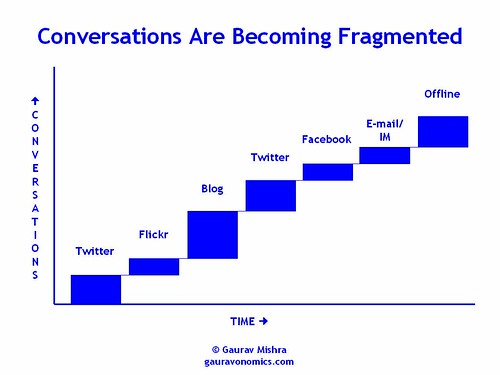
FriendFeed Loving and Why Conversation Fragmentation is Your Friend, Not Your Enemy
First more FriendFeed love. I really LIKE this service, but I loved 1995 style forums. I used bulletin board services in the early 1980s and was on Usenet at least since since the late 80s (rec.arts.scifi!). I can’t remember all of my IDs from the 1980s but here’s the oldest post in the Usenet groups by me that I could find, a post from almost 15 years ago trying to help someone out with a video driver question for the IBM OS/2 operating system. Soon I will buy an iMac and revisit my “dual boot” years. Anyway, there’s so much bullshit with monikers like “Web 2.0”. There’s not really much new under the sun, there’s just new ways to do it, and some are better.
Twitter really is new in that it’s the first “broadcast” (one-to-many) instant messaging service to crop up, but for the most part minus all the complete attention whoring and self-promoting, it seems many just use it as a giant chat room. I have no issues with any of that (not the chat room aspects, not the attention whoring and not the self-promotion), but to a large degree having experienced chat rooms since the mid 1980s, I’m pretty much over it. I understand also why MySpace and Facebook are particularly popular, but also: over it.
In almost a year on Facebook, I’ve got 50 friends, and in the last 6 months have probably added only 2-3. I’m not looking to work that network. I’m actually not looking to work any network. That probably explains why after almost a year on Twitter, I’m following 38 people and have 88 people following me. On FriendFeed, which I’ve only been active on really for about a month or so, I am already following 87 people and 53 people are following me.
I’m not sure whether FriendFeed will just be a passing phase for me. They need to expand the features around “hide” to truly make the service useful to me in a way that would allow subscribing to hundreds. But even in its current state the “hide” feature is extremely useful. The search on FriendFeed is very good too. But what I like about it is the way it’s not like Twitter or Facebook, and that’s this: it’s really easy to keep your eye on conversations, find like-minded people to subscribe to, and – and this is the big one – really easy to just jump in and participate in conversations.
Now back to the comment/conversation fragmentation. Ironically, the people who seem to be the most outspoken on this are people who’d claim the interwebs are ALL about the conversation. To some degree I agree with that sentiment, but you can’t control the conversations even if even if you start them.
For example, while I’m completely apolitical I know beyond any shadow of a doubt that there are a whole lot of days where Arianna Huffington or Bill O’Reilly start a conversation that is had by perhaps MILLIONS of people. And to the degree those conversations happen on the Internet, they happen all over the place. Do you think Arianna or Bill O. give a rat’s ass about that? No fraking way!! They’re just happy to get people talking. Bloggers should work the same way, but because perhaps due to concerns over web traffic it seems like it’s more important to some of them to “own” the conversations their posts generate on THEIR blogs.
That truly falls into the category of cutting off your nose to spite your face and it’s just dopey. All those fragmented conversations do wind up driving traffic to your blogs, it’s just not always easy to quantify. On TVbytheNumbers.com for example, we get lots of traffic referrals from hundreds of conversations about television going on via PHPBBS and other online discussion forums. If there were some easy way to group all the referral traffic coming from discussion forums it would likely be our #2 referrer overall, right behind Google.
Do I wish those people would comment on our blog instead? Not really and some of them do. Mostly, I’m just happy they found some of our info useful and useful enough to mention it and post a link to it wherever they felt like discussing it. Sometimes the resultant conversations (I have followed them from time to time) on those forums are pretty interesting, but I don’t feel like we “own” it, even if some post of ours generated the discussion. There’s no way (none, nada, zilch, zip, zed, zero, etc) to control these conversations and why would we want to?
The whole reason for doing the blog to begin with was we thought we’d be filling a useful niche. Anything that points to that outcome – like a link from a discussion forum about the CW show Supernatural – we view that as validation of our original premise. We view that as very good, and not bad in any way. Comment fragmentation is actually your friend. Whether it happens on FriendFeed or anywhere else. Anyone who disagrees with that truly is cutting of their noses to spite their face.
Conversation fragmentation is a good thing and you might as well embrace it because resistance is definitely futile.
Sunday, May 4, 2008
Scoble Has the FriendFeed Religion!
 Robert Scoble is religious. At least when it comes to being an early adopter of Internet technology. He had the Facebook religion. And the Twitter religion. Now he has the fervor for FriendFeed. I doubt it will move him to speaking in tongues, but hopefully he’ll go through a bottle of red and then get a video up with him on the whiteboard talking about how FriendFeed will kill Google.
I’m only mocking Scoble a little bit here in jest. I like early adopters and I admire his energy. Lord knows, I don’t have as much. I was in Fast Company before Scoble, but I was publishing on the Web before him, too. We didn’t call it Blogging back then, we just called it web publishing or having a web site. Back then I had more energy and cared a lot more. But that was 10 years ago and I was younger, dumber and more naïve, too. About two weeks after that Fast Company article came out I realized Microsoft wasn’t really all that interested in what I thought, but as an influencer of the influencers they wanted to make sure I didn’t go putting any wacky ideas into Walt Mossberg’s head.
Anyway, I think the third time may be the charm with Scoble religion. It's not a Google killer, but there’s something to FriendFeed and it goes like this: Facebook may be a better way to stay in touch with your real friends, but if you’re interested in “the conversation”, FriendFeed takes WAY better advantage of Zuckerberg’s notion of the beloved “social graph” than even Facebook does.
Getting to watch a conversation and not just among “your friends” but “friends of friends” who participate is very easy and unique to anything I’ve seen so far.
While I’m not sure how FriendFeed will make money, AdSense style advertising on FriendFeed seems like it might make more sense than it would on either Twitter or Facebook. I don’t see how that can be bad for FriendFeed. Either way I really hope Scoble goes to the whiteboard with why FriendFeed is a
